I have written nine books about Asia, the two Koreas, the U.S. alliance system in Asia, the politics of sports and Chinese economic coercion.

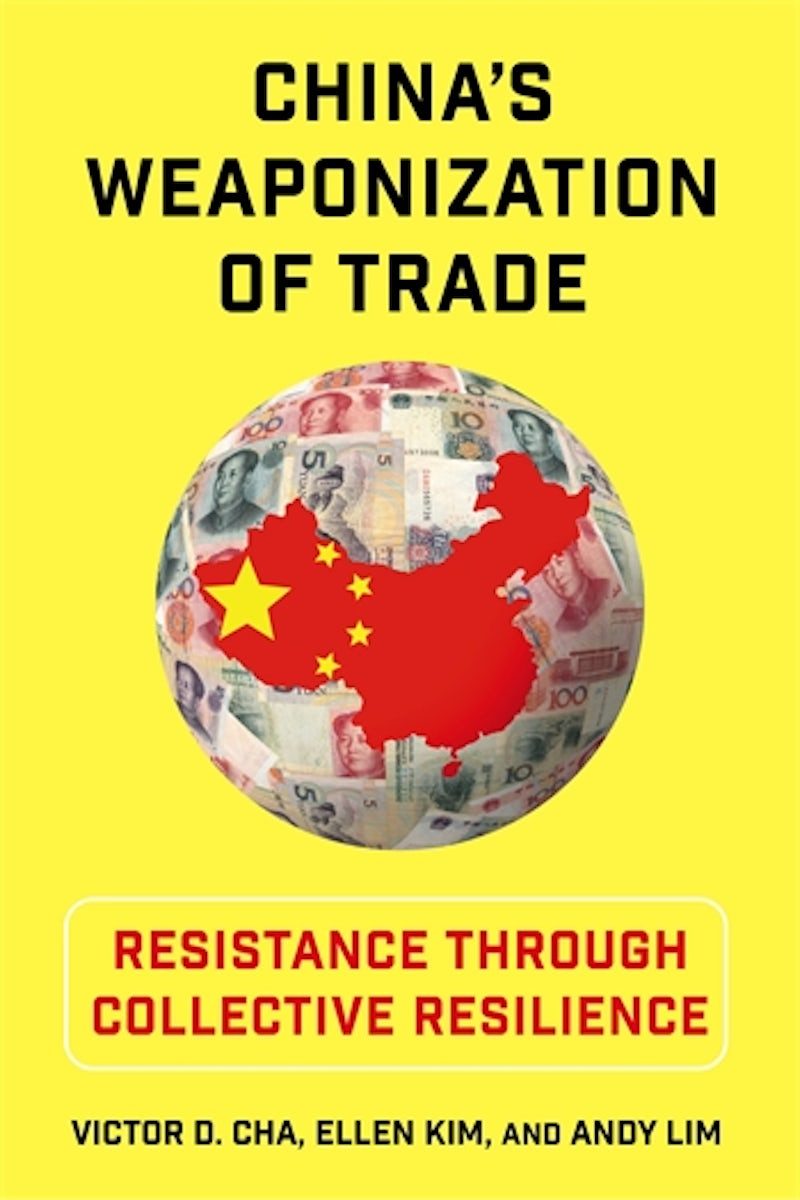
China’s Weaponization of Trade:
Resistance Through Collective Resilience

January 2026, Columbia University Press


In recent years, China and the United States have each turned economic interdependence into an instrument of coercion, using their dominant positions in international trade to push states and firms to comply with their political goals. What is distinctive about this form of economic pressure, and how can other countries fight back?

This groundbreaking book explores the weaponization of economic interdependence and its implications for the international order through a wealth of new and original data on China’s economic statecraft. Victor D. Cha, Ellen Kim, and Andy Lim examine how and in what ways the United States and China have deployed economic coercion, focusing on China’s extensive use of this tactic over the past three decades. They analyze a vast data set that includes more than 600 cases of China’s economic bullying of states, companies, and individuals in North America, Asia, and Europe. Cha, Kim, and Lim propose a multilateral strategy of “collective resilience” to counter intimidation, showing how targeted states can band together, leverage trading relationships, and threaten retaliation.

Synthesizing new insights from unique trade data with international security expertise, this timely book sheds new light on how China exercises economic power—and it provides a playbook to deter bullies and rebalance the global order.

To purchase, visit your local bookstoreAmazonBarnes & NobleBookshop, or University Press.

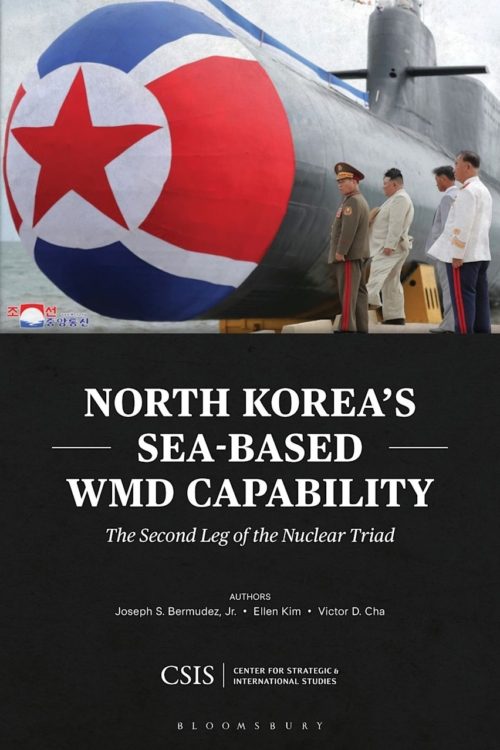
North Korea’s Sea-Based WMD Capability

2025, Bloomsbury

Utilizing the first-ever linguistic analysis of North Korean nuclear doctrine, this definitive study of North Korea’s nuclear ballistic submarine and missile programs fills in important information and intelligence gaps regarding the nation’s nuclear capabilities.

North Korea’s ongoing development of submarine forces and sea-based ballistic missile capabilities indicates that the country is striving to achieve the second leg of the nuclear triad. If successful, this will present a new national security challenge to the United States by enabling North Korea to boast a survivable nuclear weapons force. This book offers the most definitive study of North Korea’s ballistic missile submarine (SSB), submarine-launched ballistic missile (SLBM), and submarine-launched cruise missile (SLCM) programs, filling in important information and intelligence gaps regarding these capabilities, their origins, and sources of technology, as well as the current stage of these programs. This study investigates the strategic doctrine surrounding these programs by employing the first-ever data-scraping linguistic text analysis experiment of 26 years of North Korean statements and documents about their nuclear programs.

To purchase, visit your local bookstoreAmazon, or Bloomsbury.

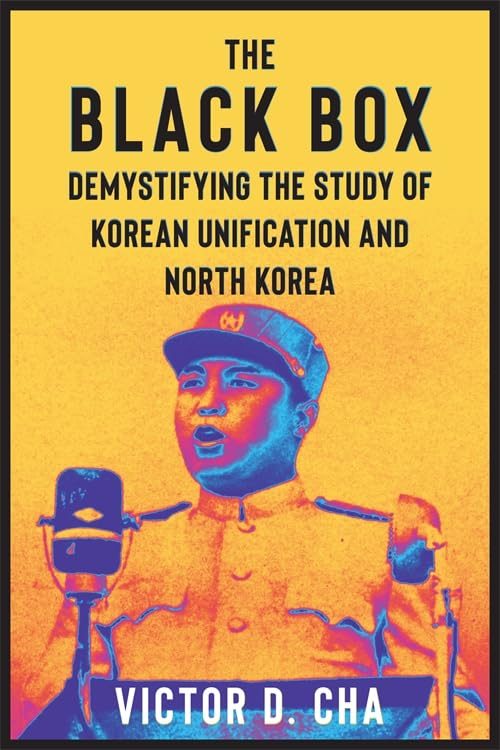
The Black Box:
Demystifying the Study of Korean Unification and North Korea

2024, Columbia University Press


“[The Black Box] calls on privileged insights into North Korea. Peace, human rights, and change will only come about by adopting fresh approaches of inquiry, to which the authors of this important book summon us.”

– The Hon. Michael Kirby, Chair of the UN Commission of Inquiry on North Korea (2013-14)

The Black Box will surely transform how scholars and practitioners study and think about North Korea and the future of Korean unification.”

– Andrew Yeo, author of State, Society, and Markets in North Korea


North Korea is commonly thought of as the most mysterious place in the world. The country is marked by its opacity and inaccessibility, its inner workings seen as impossible for outsiders to grasp. In this groundbreaking book, the leading scholar and practitioner Victor D. Cha shines a light into the “black box” of North Korea and draws critical lessons for the possible reunification of Korea after many decades of division.

The Black Box demonstrates convincingly that North Korea, while far from transparent, is less inscrutable than is typically assumed. Using innovative research methods from data scraping to ethnography, including microsurveys of ordinary North Koreans, Cha unearths a trove of new information. Through these pioneering findings, and incorporating his experiences as a White House official negotiating with North Korean interlocutors and traveling to North Korea, he paints a vivid picture of this enigmatic country and develops a grounded account of its behavior.

To purchase, visit your local bookstoreAmazonBarnes & NobleBookshop, or University Press.

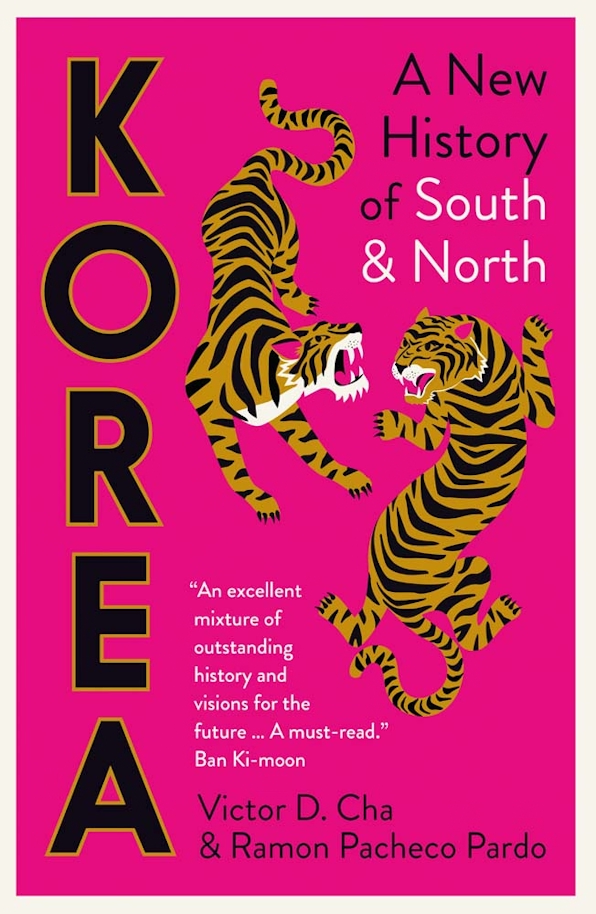
Korea:
A New History of South and North

2023, Yale University Press


Korea gives the answer to the lingering enigma of how two extremely different systems, one globally flying and the other falling to the bottom, have evolved from the same people—and where they will go from here. . . A must-read.”

– Ban Ki-moon, 8th Secretary General of the UN


“A highly readable history of the Korean peninsula. . . A must-read to understand how one ill-informed moment in history led to an ongoing human tragedy and geopolitical challenge.”

– Anna Fifield, Asia-Pacific editor, Washington Post


Korea has a long, riveting history—it is also a divided nation. South Korea is a vibrant democracy, the tenth largest economy, and is home to a world-renowned culture. North Korea is ruled by the most authoritarian regime in the world, a poor country in a rich region, and is best known for the cult of personality surrounding the ruling Kim family. But both Koreas share a unique common history.
 
Victor Cha and Ramon Pacheco Pardo draw on decades of research to explore the history of modern Korea, from the late nineteenth century, Japanese occupation, and Cold War division to the present day. A small country caught amongst the world’s largest powers—including China, Japan, Russia, and the United States—Korea’s fate has been closely connected to its geography and the strength of its leadership and society. This comprehensive history sheds light on the evolving identities of the two Koreas, explaining the sharp differences between North and South, and prospects for unification.

To purchase, visit your local bookstoreAmazonBarnes & NobleBookshop, or University Press.

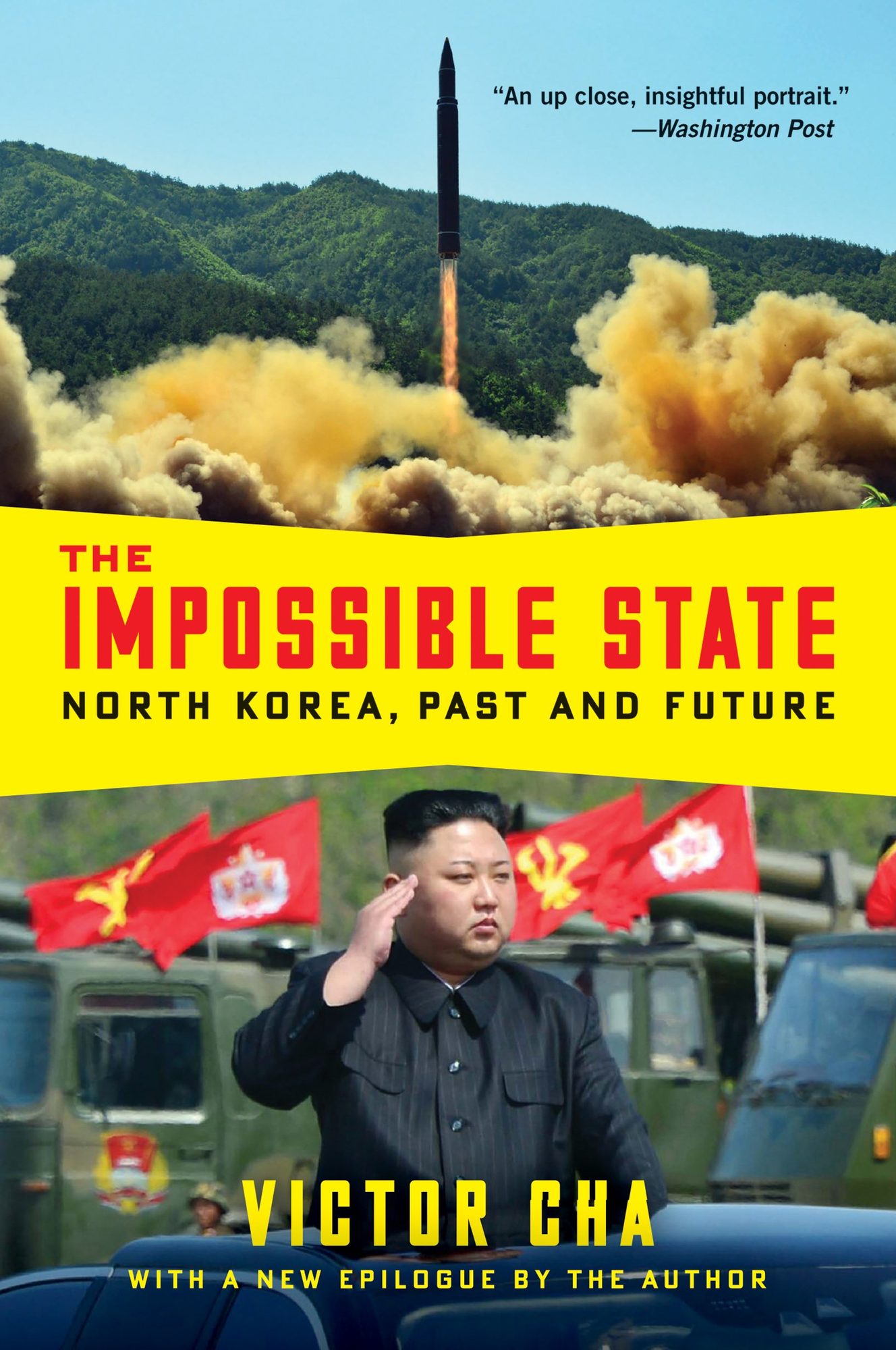
The Impossible State:
North Korea, Past and Future

2018, HarperCollins (updated edition)
Selected by Foreign Affairs as a Best Book on the Asia-Pacific for 2012


“An up-close, insightful portrait. . .The Impossible State is a clearheaded, bold examination of North Korea and its future.”

The Washington Post


“Cha demonstrates an intimate familiarity with the regime’s contradictions . . . The thesis is clear: the world’s most closed-off state needs to open up to survive, but breaking its hermetic seal may well precipitate its demise.”

The New Yorker


In The Impossible State, seasoned international-policy expert and lauded scholar Victor Cha pulls back the curtain on this controversial and isolated country, providing the best look yet at North Korea’s history, the rise of the Kim family dynasty, and the obsessive personality cult that empowers them. He illuminates the repressive regime’s complex economy and culture, its appalling record of human-rights abuses, and its belligerent relationship with the United States, and analyzes the regime’s major security issues—from the seemingly endless war with its southern neighbor to its frightening nuclear ambitions—all in light of the destabilizing effects of Kim Jong-il’s recent death.

How this enigmatic nation-state—one that regularly violates its own citizens’ inalienable rights and has suffered famine, global economic sanctions, a collapsed economy, and near total isolation from the rest of the world—has continued to survive has long been a question that preoccupies the West.

With rare personal anecdotes from the author’s time in Pyongyang and his tenure as an adviser in the White House, this engagingly written, authoritative, and highly accessible history offers much-needed answers to the most pressing questions about North Korea and ultimately warns of a regime that might be closer to its end than many might think—a political collapse for which America and its allies may be woefully unprepared.

To purchase, visit your local bookstoreAmazonBarnes & NobleBookshop, or publisher.

Nuclear North Korea:
A Debate on Engagement Strategies

2018, Columbia University Press (updated edition)

“[Cha and Kang’s] contribution is important for its frank discussion of the possibility of a nuclear attack and their presentation of potential courses of action.”

– Concepción De León, The New York Times

“This volume is an indispensable tool not only for all those working in the field of Korean Studies but also for all those dealing with International Relations theory.”

International Spectator


Victor D. Cha and David C. Kang’s Nuclear North Korea was first published in 2003 amid the outbreak of a lasting crisis over the North Korean nuclear program. It promptly became a landmark of an ongoing debate in academic and policy circles about whether to engage or contain North Korea. Fifteen years later, as North Korea tests intercontinental ballistic missiles and the U.S. president angrily refers to Kim Jong-un as “Rocket Man,” Nuclear North Korea remains an essential guide to the difficult choices we face.

Coming from different perspectives—Kang believes the threat posed by Pyongyang has been inflated and endorses a more open approach, while Cha is more skeptical and advocates harsher measures, though both believe that some form of engagement is necessary—the authors together present authoritative analysis of one of the world’s thorniest challenges. They refute a number of misconceptions and challenge the faulty thinking that surrounds the discussion of North Korea, particularly the idea that North Korea is an irrational actor. Cha and Kang look at the implications of a nuclear North Korea, assess recent and current approaches to sanctions and engagement, and provide a functional framework for constructive policy. With a new chapter on the way forward for the international community in light of continued nuclear tensions, this book is of lasting relevance to understanding the state of affairs on the Korean peninsula.

To purchase, visit your local bookstoreAmazonBarnes & NobleBookshop, or University Press.

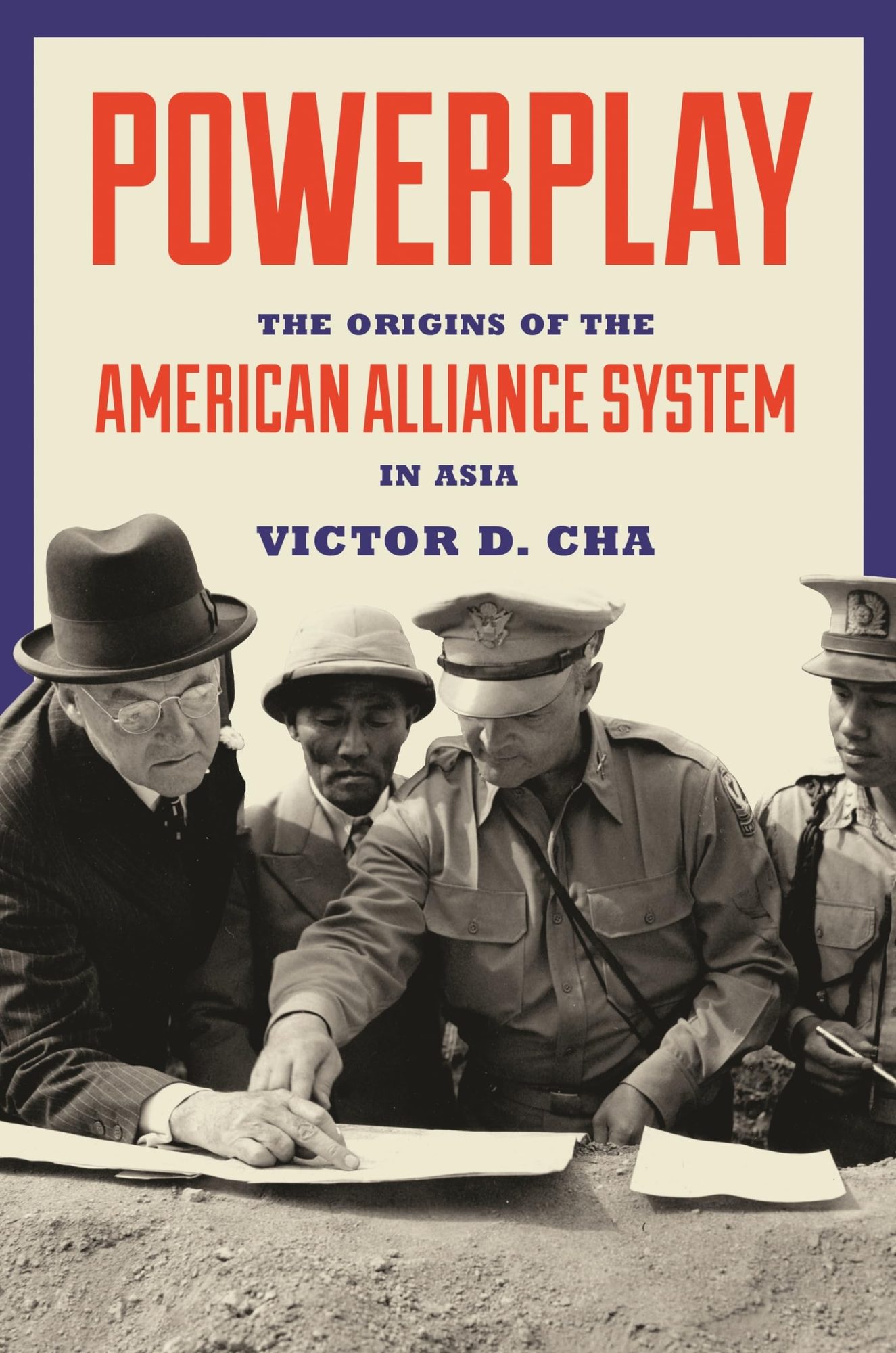
Powerplay: The Origins of the American Alliance System in Asia

2016, Princeton University Press


“Powerplay is an illuminating and important book that should help to guide policy makers as they try to cope with the greatest challenge to the American alliance system in Asia since it was created some seven decades ago: the rise of a power, China, that wants to shake it up.”

– Richard Bernstein, The Wall Street Journal


“Cha has embedded a lively narrative of post-World War II diplomatic history inside a thought-provoking analytic framework.”

– Andrew Nathan, Foreign Affairs


In Powerplay, Victor Cha draws from theories about alliances, unipolarity, and regime complexity to examine the evolution of the U.S. alliance system and the reasons for its continued importance in Asia and the world.

Cha delves into the fears, motivations, and aspirations of the Truman and Eisenhower presidencies as they contemplated alliances with the Republic of China, Republic of Korea, and Japan at the outset of the Cold War. Their choice of a bilateral “hub and spokes” security design for Asia was entirely different from the system created in Europe, but it was essential for its time. Cha argues that the alliance system’s innovations in the twenty-first century contribute to its resiliency in the face of China’s increasing prominence, and that the task for the world is not to choose between American and Chinese institutions, but to maximize stability and economic progress amid Asia’s increasingly complex political landscape.

Exploring U.S. bilateral relations in Asia after World War II, Powerplay takes an original look at how global alliances are achieved and maintained.

To purchase, visit your local bookstoreAmazonBarnes & NobleBookshop, or University Press.

Beyond the Final Score:
The Politics of Sport in Asia

2009, Columbia University Press


“Victor D. Cha has written an essential guide to how and why the playing fields of the Asian-Pacific region matter to us all.”

– Kurt Campbell


“A fun book about a serious topic.”

– Orville Schell


The Beijing Olympics will be remembered as the largest, most expensive, and most widely watched event of the modern Olympic era. But did China present itself as a responsible host and an emergent international power, much like Japan during the 1964 Tokyo Games and South Korea during the 1988 Seoul Games? Or was Beijing in 2008 more like Berlin in 1936, when Germany took advantage of the global spotlight to promote its political ideology at home and abroad?

Beyond the Final Score takes an original look at the 2008 Beijing games within the context of the politics of sport in Asia. Asian athletics are bound up with notions of national identity and nationalism, refracting political intent and the processes of globalization. Sporting events can generate diplomatic breakthroughs (as with the results of Nixon and Mao’s “ping-pong diplomacy”) or breakdowns (as when an athlete defects to another country).

For China, the Beijing Games introduced a liberalizing ethos that its authoritative regime could ignore only at its peril.

To purchase, visit your local bookstoreAmazonBarnes & NobleBookshop, or University Press.

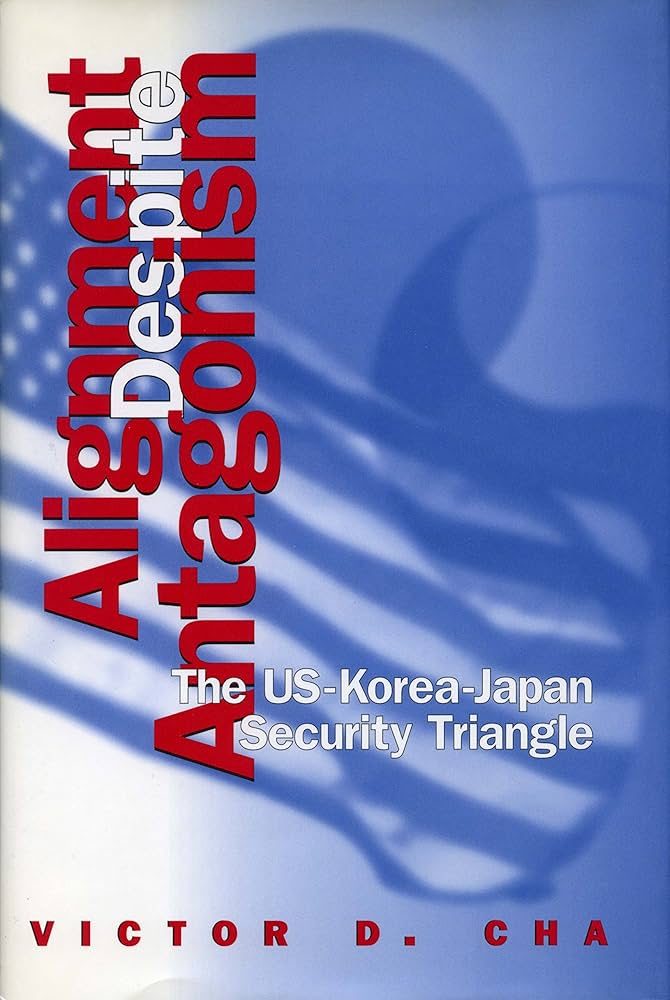
Alignment Despite Antagonism:
The United States-Korea-Japan Security Triangle

1999, Stanford University Press
Winner of the Masayoshi Ohira Foundation Book Prize, 2000


“Cha’s work represents a landmark in the study of South Korea-Japan relations and a new starting place for all future studies on these crucial ties. Cha’s study may be the most systematic and objective study of South Korea-Japan security ties thus far, and his analysis explains more than existing explanations.” – The Journal of Asian Studies

“The book’s stengths are both theoretical and empirical. Cha develops a very good framework that yields testable predictions about how U.S.-Japan-ROK relations should change. The empirical chapters set out important history . . . and work very well for testing the theory.” – Robert Jervis, Columbia University

Japan and the Republic of Korea (ROK) have been two of the most critical pillars of peace, stability, and prosperity in the Asia-Pacific region for the past thirty years. At the same time, their relationship has fluctuated markedly and unpredictably. Despite the existence of a common ally in the United States and common security threats from the former Soviet Union, China, and North Korea, bilateral relations between Japan and South Korea have been persistently marred by friction.

In the first in-depth study of this puzzling relationship in over fifteen years, the author compares the commonly accepted explanation for this relationship—historical enmity—with one that focuses on policies of the United States as the key driver of Japan-ROK relations. He finds that while history and emotion certainly affect the ways in which Japanese and Koreans regard each other, cooperation and dissension in the relationship are better understood through what he calls a “quasi-alliance” model: two states that remain unallied but have a third party as a common ally.

This model finds that the “normal” state of Japan-ROK relations is characterized by friction that stems not only from history, but also from fundamental asymmetries in Japanese and Korean expectations of support from each other. The author shows, however, that in periods when the American defense commitment to the region is weak, Japan-ROK relations exhibit significantly less contention over bilateral issues. Without the prop of U.S. assistance, the two countries are seemingly willing to overlook the usual causes of friction and to adopt a more pragmatic approach. The author discusses the effects of democratization and the post-Cold War era on the triangular relationship, and addresses the prospects of a united Korea and its future relations with Japan, the United States, and China.

The book covers the period from 1965 to 1998 and draws on recently declassified U.S. documents, internal Korean government documents, and interviews with former policy makers in the United States, Japan, and Korea.

To purchase, visit your local bookstoreAmazonBarnes & NobleBookshop, or University Press.